What the Quiet Teaches: The Role of Intentional Stillness in the Jay's Dining Experience

Photo: PattayaPatrol, CC BY-SA 4.0, via Wikimedia Commons
There is a moment that occurs in every great meal—one that rarely appears on any menu and is almost never discussed in reviews. It arrives somewhere between the removal of one course and the arrival of the next, when the table settles, conversation softens, and the room seems to draw a slow, collective breath. Most guests experience it without registering it consciously. At Jay's Restaurant Group, we have spent years learning to protect it.
The American dining landscape has, for decades, trended toward volume. Open kitchens amplify the percussive rhythm of line work. Curated playlists layer sound upon sound. The prevailing assumption has been that energy and noise are synonymous—that a full, lively room signals a successful restaurant. We have never fully accepted that equation. What we have come to believe, through observation and practice, is that silence—used with intention and precision—is among the most powerful tools available to a dining establishment. It does not diminish an experience. It deepens it.
The Space Between Courses
Consider the interlude between a first and second course. In many restaurants, this gap is treated as dead time, something to be filled or minimized. Servers are trained to move quickly, to ensure the guest never feels forgotten or unattended. The instinct is understandable, but we believe it misreads what guests actually need.
When a beautifully composed plate is cleared from the table, something subtle happens in the minds of those who have just experienced it. Flavor memory is still active. The conversation that the dish inspired—its origin, its texture, the way it recalled a childhood meal or a trip taken years ago—is still finding its shape. Rushing the next course into that space interrupts a process that is, in its own right, part of the dining experience.
At Jay's, our service teams are trained to read that interlude rather than fill it. A pause of the right duration is not negligence. It is consideration. It is the acknowledgment that a guest's relationship with a meal is not purely transactional, and that memory is made not only in the moments of eating but in the quiet that follows.
Silence as a Form of Hospitality
Western hospitality culture tends to conflate attentiveness with presence. The assumption is that a guest who is being well-served is a guest who is consistently engaged—by a server, by ambient sound, by the sensory architecture of the room. What this model misses is that genuine attentiveness sometimes means stepping back.
There is a concept in high-level service sometimes referred to as "invisible presence"—the ability of a service professional to be entirely available without being intrusive. Jay's Restaurant Group has long embraced this standard, and silence is central to it. Our servers are not performers filling a stage. They are stewards of an experience, and part of that stewardship involves knowing when the most generous thing they can offer is an uninterrupted moment.
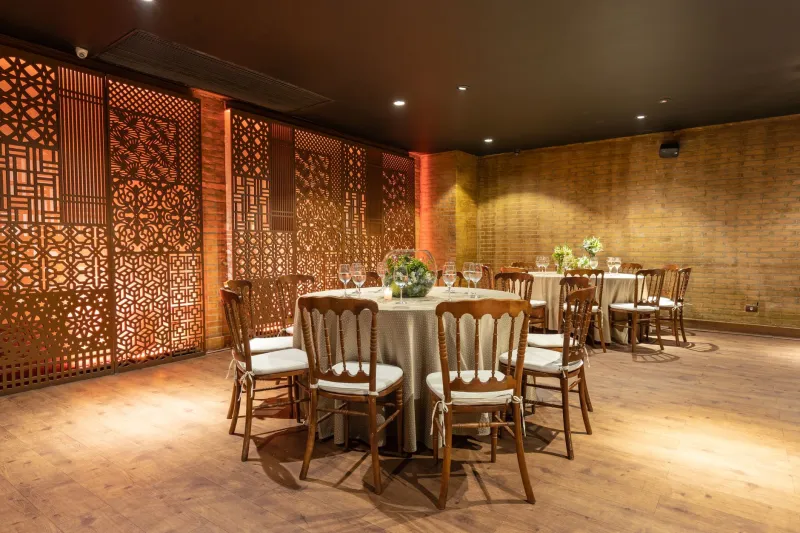
This philosophy extends to the physical design of our dining rooms. Acoustic considerations are woven into every space we operate. The goal is never to create rooms that feel hushed or sterile, but rather rooms that allow conversation to exist at a human scale—where two people seated across from one another need not raise their voices, and where the ambient sound of the room supports rather than overwhelms the experience of being present.
The Kitchen at Rest
The discipline of intentional stillness does not belong exclusively to the front of house. In our kitchens, the transitions between service stages carry their own form of quiet—moments when the pace of preparation shifts, when the line resets, when the collective focus of a culinary team narrows before the next push begins.
Our executive chefs speak of these transitions with a kind of reverence. The seconds before a composed plate leaves the pass are, in many ways, the quietest in a kitchen's rhythm. Every element has been accounted for. The decision-making is complete. What remains is the act of sending something into the world and trusting that the care embedded in its preparation will be received.
This internal stillness—brief, disciplined, almost meditative—has a direct bearing on the quality of what reaches the table. A kitchen that never pauses is a kitchen that never reflects. And reflection, however compressed, is what separates technically proficient cooking from cooking that communicates something.
Memory Is Made in the Margins
Research in sensory psychology has long suggested that human memory is disproportionately shaped by contrast. We remember peaks and transitions more vividly than we remember sustained, uniform experiences. A meal that moves at a relentless pace, however excellent its components, risks becoming a blur. The moments that linger in memory—the ones guests return to when they recommend a restaurant to a friend or recall a celebration years later—are often the moments that existed at the edges of the main event.
The pause before dessert. The quiet after a toast. The unhurried beat between the presentation of a wine and the first pour. These are the margins of a meal, and at Jay's Restaurant Group, we believe the margins are where lasting impressions are formed.
This is not a passive philosophy. It requires active cultivation. It means resisting the pressure to fill every moment with stimulation, trusting that our guests are capable of sitting with an experience rather than simply moving through it. It means training our teams to value restraint as highly as responsiveness. And it means designing menus, spaces, and service sequences with the understanding that what we choose not to do is as consequential as what we choose to do.
An Invitation to Be Present
Ultimately, the stillness we build into every Jay's experience is an invitation. In a culture that rarely stops moving, we are asking our guests to slow down—not because the food demands it, though it does, and not because the service requires it, though it does—but because the act of being fully present at a table with people you care about is itself worth protecting.
The best meals are not simply eaten. They are inhabited. And the space to inhabit them—the quiet, the pause, the unhurried moment between one thing and the next—is something we take as seriously as any ingredient in our kitchens.
At Jay's Restaurant Group, silence has always been on the menu. We simply believe it deserves to be acknowledged.