When Restraint Becomes a Standard: The Deliberate Choices That Keep Jay's Restaurant Group Uncompromising
There is a particular kind of courage required to turn away revenue. In an industry where margins are notoriously thin and demand is perpetually unpredictable, the instinct to say yes — to more covers, more menu items, more locations, more everything — can feel less like ambition and more like survival. Yet at Jay's Restaurant Group, the leadership team has long operated under a counterintuitive conviction: that the most powerful word in their vocabulary is, in fact, no.
This is not stubbornness. It is not indifference to the guest experience. It is, rather, the clearest expression of what Jay's has always believed hospitality to be — a promise, not merely a transaction.
The Menu That Refuses to Grow
Visitors dining at any Jay's concept for the first time often remark on the relative brevity of the menu. In an era when many American restaurants compete through sheer volume — stacking proteins, sauces, and preparation styles into catalogs that read more like encyclopedias than culinary invitations — Jay's takes a markedly different approach.
"Every dish on our menu has survived a rigorous internal process," explains one of the group's culinary directors. "We ask whether a dish can be executed at the same level of quality on a Tuesday night in October as it can on a Saturday evening in July. If the answer is anything less than an unqualified yes, it doesn't belong."
This philosophy has, on more than one occasion, led to the removal of items that guests genuinely loved. A braised short rib preparation that earned consistent praise from diners was quietly retired when the culinary team determined that the sourcing requirements could no longer be guaranteed without compromise. The decision was not made lightly. It was made deliberately — because a beloved dish served imperfectly is, in the estimation of Jay's leadership, worse than no dish at all.
The result is a menu that guests can trust entirely. When something appears on a Jay's menu, it carries with it an implicit guarantee: this item has been prepared with every available resource, and it will be executed the same way every single time.
Seating Capacity as a Statement of Values
The question of how many guests a restaurant can serve in a single evening is, in most operational frameworks, a math problem. Square footage, table configurations, turn times, and staffing ratios are calculated, optimized, and maximized. At Jay's Restaurant Group, that calculation begins from a fundamentally different premise.
"We don't ask how many guests we can fit," says one senior operations leader. "We ask how many guests we can serve exceptionally well. Those are very different questions, and they lead to very different answers."
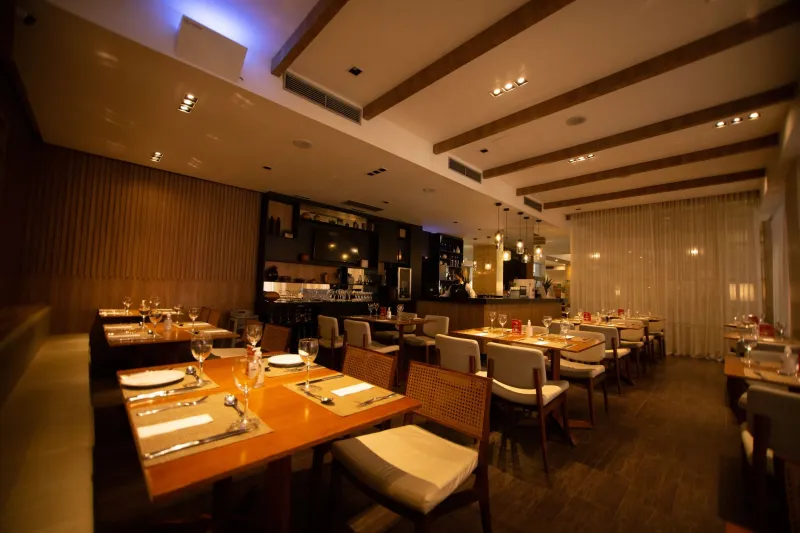
The distinction matters. A dining room filled beyond its optimal capacity is a dining room where service begins to fray at the edges — where water glasses go unnoticed, where timing between courses becomes erratic, where the attentiveness that transforms a meal into a memory quietly disappears. Jay's has chosen, consistently and without apology, to leave money on the table rather than allow that deterioration to occur.
This commitment extends to reservation practices as well. During peak periods, when demand for tables at Jay's concepts routinely exceeds availability, the organization has resisted the temptation to add seatings, compress service windows, or otherwise engineer additional capacity. The waiting list, in this context, is not a problem to be solved. It is evidence that the standard is worth waiting for.
Turning Away Business to Protect the Brand
Perhaps the most striking expression of Jay's operational philosophy came several years ago, when the group was approached about a significant private event that would have required one of its flagship dining rooms to operate beyond its standard service parameters. The financial terms were favorable. The client was prominent. By conventional measures, declining the engagement made little sense.
Jay's declined.
"We were being asked to do something we couldn't do at our level," recalls a member of the executive team who was involved in the conversation. "And the moment we agree to do something at a level below our standard — even once, even for a compelling reason — we've introduced a crack in the foundation. That crack doesn't stay small."
The decision, which circulated internally as a kind of organizational parable, reinforced something that Jay's leadership had long understood intellectually but needed to demonstrate in practice: that the brand's value is inseparable from its consistency. Guests return to Jay's not because they hope for an excellent experience, but because they expect one. That expectation is the product of hundreds of small refusals, accumulated over years, each one quietly defending the standard against the pressure to compromise.
The Guest Relationship Deepens Through Honesty
Counter to what one might expect, guests who have encountered Jay's willingness to say no — whether in the form of a dish no longer available, a reservation that cannot be accommodated, or a special request that falls outside what the kitchen can execute with integrity — frequently report that the experience strengthened rather than diminished their loyalty to the brand.
This is not accidental. There is a particular kind of respect embedded in an honest refusal. When a server at a Jay's property explains that a dish has been removed from the menu because the team was no longer satisfied with its preparation, the guest receives something more valuable than a substitute recommendation. They receive confirmation that the organization takes its own standards seriously — that the excellence they have come to associate with the Jay's name is not a marketing position but a genuine operational commitment.
"Guests are perceptive," notes one of the group's front-of-house managers. "They know the difference between a restaurant that tells them what they want to hear and one that tells them the truth. We choose the truth, even when it's inconvenient. Especially when it's inconvenient."
Restraint as a Long-Term Investment
In the broader context of American dining culture — where restaurant groups frequently scale aggressively, diversify into adjacent concepts, and pursue growth metrics that prioritize reach over depth — Jay's Restaurant Group occupies a distinctive position. Its refusal to expand beyond what it can execute with excellence is, in the long view, not a limitation. It is a competitive advantage.
Guests who dine at a Jay's concept know, with a confidence that is increasingly rare in the industry, what they are going to receive. That certainty is the product of years of deliberate restraint — of menus curated rather than inflated, of dining rooms configured for care rather than capacity, of a leadership team willing to absorb short-term costs in service of a long-term standard.
Saying no, at Jay's Restaurant Group, has never been easier. It has simply always been right.